
For the past five years, I’ve had the honour and pleasure of playing a role in Lancaster University’s wonderful “Introduction to Eco-Innovation” course.
This course helps students to understand how environmental and social ideas can be commercialised, with a particular focus on innovation. It requires them to create a detailed business plan for an innovative idea, which they use to request investment from a theoretical investor.
My role is to act as a “dragon” – a potential investor – that the students have to pitch to. My fellow dragons and I mark the students on a range of criteria, considering the potential impact of the idea, the way in which the investment will be used, it’s potential to scale, and the quality of the presentation.
I absolutely love taking part in this course, and every year I’m both heartened and deeply moved to see the incredible ideas the students come up with.
Supporting the UN Sustainable Development Goals
A key aspect of the student’s work is to show how their innovation supports one or more of the UN Sustainable Development Goals. This helps the students consider how their innovation will contribute to at least one of the 17 goals agreed by 193 world leaders.
The ideas contributed to a broad range of goals, including not only environmental goals like Climate Action (Goal 13), but also social and economic goals such as Clean Water and Sanitation (Goal 6) and Decent Work and Economic Growth (Goal 8). I was particularly impressed to see a number of students aligning with specific targets relating to these goals!
Learning commercial skills
For each presentation, the students work as a team and act in specific roles relating to their business – e.g. finance, sustainability, HR, marketing, etc. This really helps them to understand how these difference parts of a business need to work together.
They have to show a clear plan detailing the level of investment needed for the innovation, how it will be spent in year one, and how they expect to create returns in future years, outlining challenges that they anticipate.
I’m always impressed by the level of detail that the students put into these commercial plans. I’ve watched countless pitches over the years from new and established businesses, many of which don’t have the same level of detail!
Pitching to Dragons
Each group of students works as a team and pitches their innovation in a Dragon’s Den-style format to a group of theoretical investors. Granted, I’m not a particularly scary Dragon, but I still think it takes incredible courage for these young people to stand in a room and present their ideas in this way.
Each member of the team plays a part in the presentation, taking on the role they’ve been assigned as part of the project.
Honestly, I’ve learned things from these students on how to present effectively. We had quizzes to get the Dragons engaged, sample products handed out – one team even dressed up in outfits linked to their innovation!
Incredible ideas
Every year, I’m blown away by the wonderful ideas that everyone comes up with to help make a better world. It always makes me quite emotional to realise the sheer depth of passion and talent these people have.
This year’s ideas were particularly impressive, ranging from reusing Cassava husks to improve food yield in Nigeria to using waste plastic as flotation devices that prevent household items from flood damage in Bangladesh.
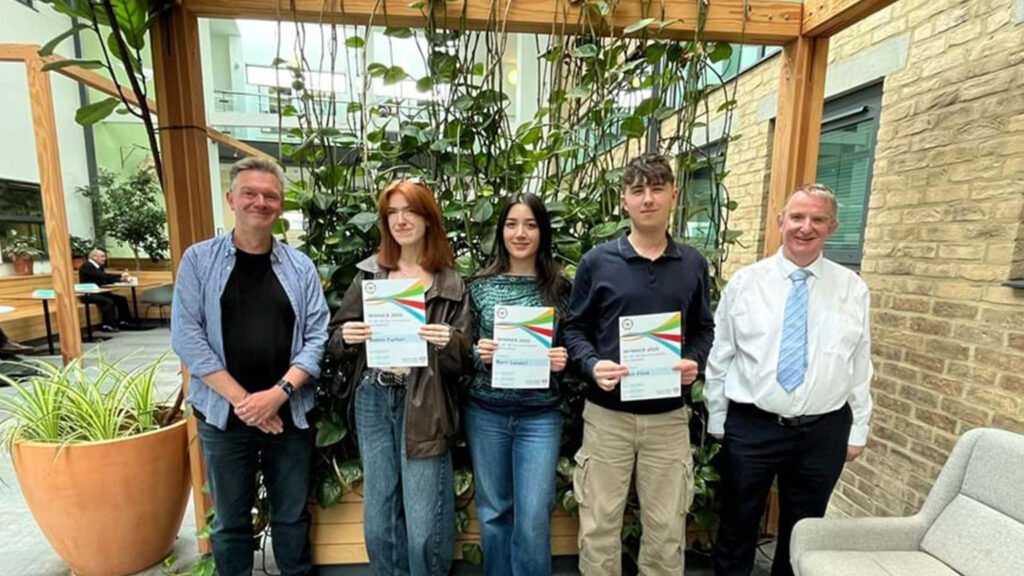
The winning team gave a fantastic pitch, requesting £25,000 investment for a business that distributes biochar – a charcoal-like substance, which the team proposed would be created from wildfire residue in Australia and used to restore damaged land, improving fertility while also reducing the risk of new wildfires.
I was impressed not only by the quality of the pitch, but also the detailed commercial plan as well as the way in which they’d come up with a solution that aligned perfectly with the concept of a circular economy, supporting Goal 12 – Responsible Consumption and Production.
It was a pleasure to present the winning team with a voucher to be spent on campus, and certificates to celebrate their achievement. You can see more about the winning team at https://www.lancaster.ac.uk/lec/about-us/news/winning-students-champion-eco-innovation.
We’re in good hands
In my early twenties, I had no idea what I wanted to do. I’d certainly never created a business plan or presented a pitch to investors, and I definitely hadn’t come up with any ideas that could make the world a bit better.
Witnessing the ability and passion of these young people gives me enormous hope for our future. I feel so privileged to play a part in helping to nurture their talent in some small way, and I know they’ll have a bright future.
My sincere thanks to the wonderful Professor Nigel Watson at Lancaster University who does such an amazing job running this course, and to the other “Dragons” involved. It’s an honour to join you every year.


